Create Your First Project
Start adding your projects to your portfolio. Click on "Manage Projects" to get started
Patterns in Currency - Design I
Date
August 2025
Empathy
The Philippines is a country with a strong, admirable culture. The collectivist attitude of its citizens fosters a community of support and thoughtfulness. In addition, religion plays a large role in the Philippines with festivals and rituals being held regularly. Sacred places such as Mount Banahaw and the Basilica Del Santo Niño provide spaces where Filipinos come together and celebrate their heritage. Whether it is through textile weaving or street food like kwek kwek, the country shows its unique spirit in many ways. All of these factors led me to choose the Philippines as the country for the currency I would redesign. Furthermore, I have many friends that are from the Philippines who always talk about their country fondly.
One of these people is my good friend Dustinne. The first question I asked her was about the image that first comes to her mind when she thinks about her country. She answered that her relatives' homes were the first to come to mind, followed by the beaches of Boracay. When I asked what the cheapest foods to buy there were, she answered Filipino street food but specifically mentioned kwek kwek. The last main thing we covered was if she liked the current currency design. She emphasized how much she likes the different colors as well as the animals that are featured on the backside of the bills. When I asked if there was anything she would want to change, there was nothing that she could think of.
Define
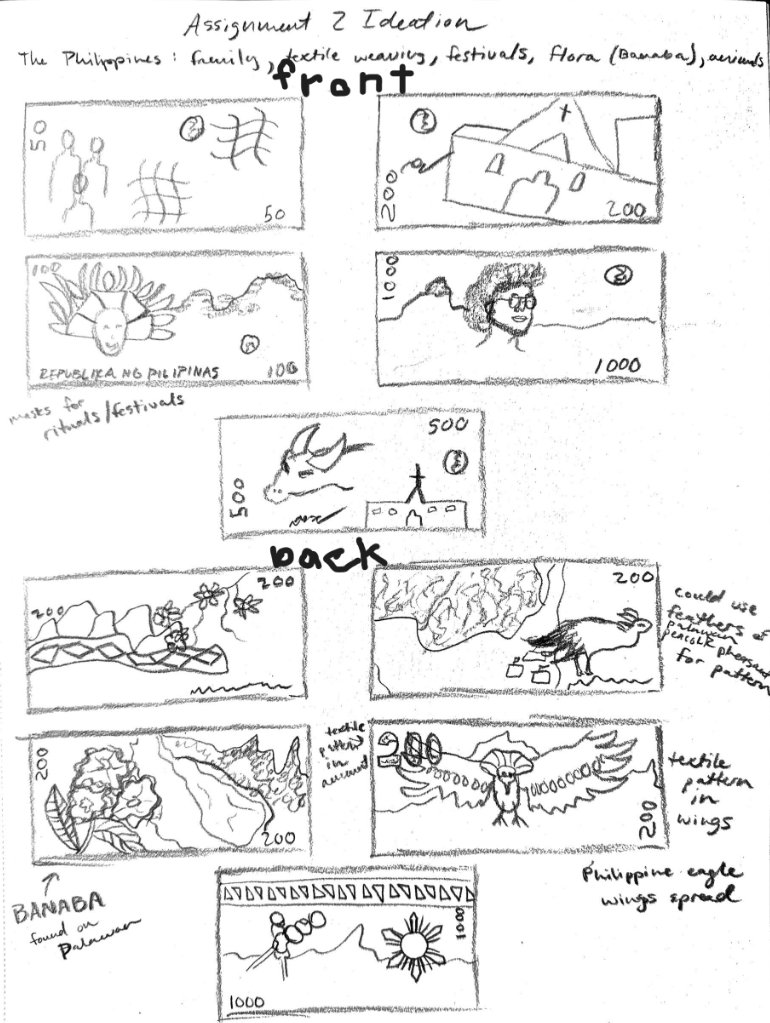
From the start of this process, I wanted to be sure I was best representing the Phillipines through the elements I chose. It was important that I kept the vibrant coloring that the current bills have as well as the featured animal on the back side. I did further research to find five elements I wanted to prioritize when it came to starting my ideation process: festivals, flora, family, animals, and textile weaving. Once I finalized these, I began by creating 10 sketches with 5 being for the front of the bill and 5 being for the back. After getting feedback, I knew I wanted to use the festival as a theme for the front while focusing on a significant historical place for the back. As for working toward the final composition, I wanted to work traditionally with cardstock and colored pencil to achieve this.
Feedback and Reflection
After showing my sketches from the ideation phase, I received extremely helpful feedback. I was told by Professor that the festival mask caught his attention the most out of the front sketches. Classmate 1 agreed and said that it would be interesting to use the church in the fifth ideation sketch as the background for the mask since they are both related to religion. Classmate 2 suggested that the background should include the flowers from the fourth back side sketch and that the sun from the Philippines' flag should be included in the final design. For my prototype, I implemented all of the above advice to create my first rendition. After presenting this, I was told by Professor to add a pattern to the sky on the back side of the bill and to be careful of the tangent created by the cross on top of the church on the front. Classmate 3 also said to move the text "Mount Banahaw" beside the sun for more visibility. I heeded all of this advice when finalizing my design by making sure the cross did not line up with the edge of the bill, adding a cultural pattern to the sky, and moving the text to the left of the sun. I successfully achieved my original goal by including the elements I felt best represented the research I did. While my prototype lacked detail and felt bland in some places, I made sure to add patterns to my final design. Something that worked well in my final composition was the overall balance, meaning that one area of the bill did not dominate another. However, something that did not work was the layout of the flower rings behind the festival mask as I feel I did not make them clear enough. If I were to repeat this process, I would leave more room for the flower rings in the top left corner of the bill, and I would more carefully map out the cultural patterns in pencil beforehand.